
At the same time, competitors are no longer competing only for rankings and clicks. They are also competing to become cited sources inside AI-generated search experiences, recognized entities within their subject area and trusted references across multiple search formats.
This means that a useful competitor analysis must go beyond checking backlinks, word count and keyword density. Modern SEO teams need a multi-layer competitive intelligence process that examines keyword coverage, content quality, SERP feature ownership, link acquisition, AI citation presence and publishing activity.
The goal is not to copy pages that currently rank well. The goal is to understand why competitors are visible, where their strategy is vulnerable and which opportunities your website can realistically capture.

Why Competitor SERP Analysis Has Become an Ongoing Practice
Traditional SEO competitor analysis was often performed as a quarterly exercise. A team would collect rankings, review backlinks, compare a few pages and create a static report that might not be revisited for several months.
That approach is increasingly inadequate because search results change continuously. Competitors publish new pages, update existing content, acquire links, expand topic clusters and gain access to new SERP features. Google may also change the layout of a result page without any website gaining or losing a conventional organic position.
Competitor SERP analysis should therefore be treated as an ongoing monitoring process rather than an occasional report. The frequency does not need to be identical for every keyword. High-value commercial queries may deserve daily or weekly monitoring, while lower-priority informational queries can be reviewed less frequently.
Several factors make continuous analysis increasingly important:
- SERP fluidity: Rankings for competitive queries can change as pages are updated, new content is indexed, links are acquired and search systems are refined.
- AI Overview volatility: The sources cited within AI-generated results may change as Google reassesses available content and discovers new or updated pages.
- Competitor content velocity: Active SEO teams may publish or refresh several pieces of content each month. A quarterly review can miss an entire cycle of competitor activity.
- Short recovery opportunities: When a competitor loses visibility, the opportunity to replace that page may be temporary. Fast detection gives your team more time to respond.
- Changing result layouts: A keyword can retain the same top-ranking domains while becoming less valuable because AI answers, videos, shopping results or discussion modules occupy more of the page.
- Multiple visibility surfaces: A competitor may be absent from the top three organic positions but still dominate through featured snippets, images, videos, People Also Ask answers or AI citations.
An effective monitoring system should show not only where competitors rank, but also how the composition of the SERP changes around those rankings.
Know when competitors move before they take your traffic
Compare your rankings with competing domains on the same keywords. Find the terms where they are pulling ahead, follow their movement over time and turn ranking gaps into a focused SEO action list.
No credit card required. Add the competitors that matter to each project.
Identifying Your True SERP Competitors
Your search competitors are not always the same as your direct business competitors. A business competitor sells a similar product or service, while a SERP competitor is any domain that repeatedly competes with you for visibility across your target queries.
This distinction is important because Google ranks pages according to relevance and usefulness for each search, not according to commercial categories. A software company may therefore compete with publishers, agencies, marketplaces, YouTube channels, community platforms and educational websites on the same result page.
For a SaaS company offering SERP monitoring and SEO analysis tools, search competitors might include:
- Other rank tracking and SEO software platforms
- Marketing publications such as Search Engine Land or Search Engine Journal
- SEO education websites such as Ahrefs, Moz or Backlinko
- Digital marketing agency blogs
- YouTube channels appearing within video results
- Reddit, Quora and other community platforms
- Independent consultants publishing detailed tutorials
- Template and resource websites offering free SEO tools
To identify your true SERP competitors, begin with a representative set of target keywords rather than a single high-volume term.
Take approximately 20 to 50 strategically important keywords and export the domains appearing in the top organic results for each one. Then calculate how frequently each domain appears across the complete keyword set.
Domains with the highest frequency are usually your most important SERP competitors because they repeatedly compete for visibility across the same topic space.
Frequency alone, however, is not enough. Classify each competitor by type and relevance. A domain appearing frequently for informational queries may be an important content competitor but not a commercial competitor. Another domain may appear less frequently overall while competing directly on your highest-converting keywords.
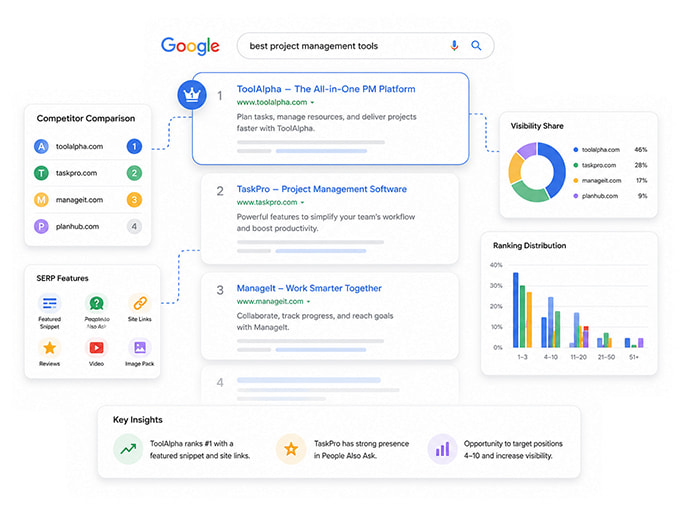
A useful competitor list should therefore include:
- Direct product competitors
- Recurring content competitors
- SERP feature competitors
- AI citation competitors
- High-authority publishers influencing the topic
This broader view gives you a more accurate picture of who is actually taking attention from your pages.
Stop guessing where your pages rank on Google
Track keyword positions across different countries, locations and devices. See ranking changes, uncover new opportunities and react before your competitors do.
No complicated setup. Add your keywords and start tracking.
The Six-Layer Competitor SERP Analysis Framework
A reliable SERP competitor analysis should evaluate multiple layers of visibility at the same time. Looking at only one layer can lead to misleading conclusions.
For example, a competitor may have fewer backlinks but stronger content coverage. Another may rank below you organically but own the featured snippet. A third may receive fewer conventional clicks while appearing more frequently as a cited source in AI Overviews.
The following six-layer framework helps connect those signals and turn them into a practical competitive assessment.
1. Keyword Coverage
Keyword coverage measures which relevant queries a competitor ranks for that your website does not. This is the foundation of content gap analysis, but the objective is not to export thousands of missing keywords and treat them all as opportunities. The useful gaps are queries that align with your product, audience, expertise and conversion path.
Review both individual keywords and the broader topic clusters they represent. A competitor ranking for 40 related queries about technical SEO audits may indicate ownership of a topic, not merely success with 40 isolated phrases.
Find the issues holding your site back before rankings drop
Crawl your website, uncover technical and on-page SEO issues, and see which pages need attention first. SerpVision groups findings by severity so your next SEO sprint starts with the fixes that matter.
No credit card required. Audit on your schedule.
2. Content Structure and Quality
For keywords where a competitor outranks you, examine how its page differs from yours. Review the depth of coverage, heading structure, answer placement, use of examples, media, tables, screenshots, authorship information, external references and update history.
Word count can be recorded, but it should not be treated as a quality metric by itself. A shorter page can outperform a longer one when it matches the search intent more precisely and communicates the answer more efficiently.
3. SERP Feature Capture
Measure which competitors appear in featured snippets, People Also Ask answers, image packs, video results, local results and other prominent SERP features. Feature ownership can explain why a domain receives disproportionate attention even when its conventional organic position appears similar to yours.
Record both current ownership and changes over time. A competitor that repeatedly gains featured snippets across related queries may have developed a content structure that is particularly effective for concise answers.
4. Backlink Profile
Review the links supporting the competitor’s domain and, more importantly, the specific pages competing with yours. The analysis should include referring domain quality, relevance, link placement, anchor context, link type and acquisition patterns.
A page with relatively few links may still be difficult to displace when those links come from highly relevant and trusted sources.
5. AI Citation Presence
For queries that trigger AI Overviews or other AI-generated search experiences, record which domains are cited and how consistently they appear.
AI citation analysis creates an additional visibility layer beyond standard rankings. A competitor may become a frequent cited source even when its page is not the first traditional result.
This layer should be evaluated separately because organic rank and AI citation frequency do not always move together.
6. Content Velocity and Freshness
Track how frequently competitors publish new pages, update old content and expand existing topic clusters. Content velocity should not be confused with publishing volume alone. A competitor releasing many weak pages is not necessarily creating a meaningful advantage.
The more useful question is whether the competitor is systematically improving coverage in your strategic topic areas. Consistent updates to high-performing pages may be more influential than frequent publication of disconnected articles.
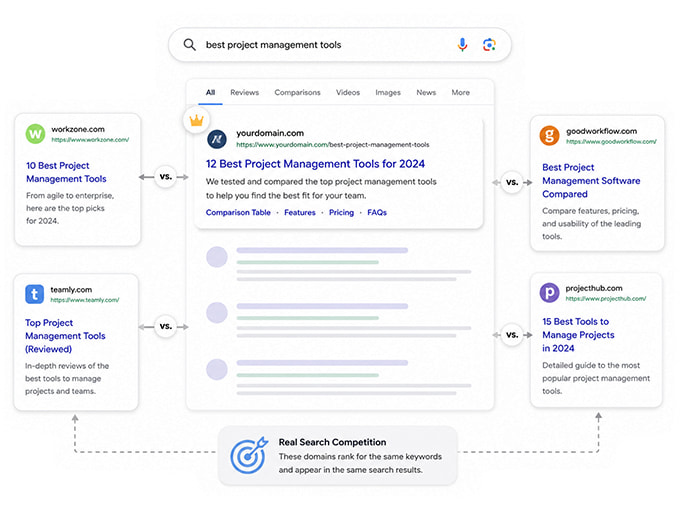
Content Gap Analysis: Finding Keywords Your Competitors Own That You Do Not
Content gap analysis identifies relevant queries and topic areas where competitors already have visibility but your website is absent, weak or positioned too low to attract meaningful attention.
The process should combine ranking data with business relevance. A keyword is not a valuable gap simply because a competitor ranks for it. It becomes a useful opportunity when the query matches your audience, supports your product positioning and can lead users toward a meaningful next action.
Step 1: Export Competitor Ranking Data
Export the organic keyword profiles of your most relevant SERP competitors using your rank tracking, competitor analysis or keyword research platform.
Start with three to five competitors that consistently overlap with your target keyword set. Mixing direct competitors with strong educational publishers can reveal both commercial and informational gaps.
Step 2: Compare Competitor Keywords With Your Own Rankings
Cross-reference competitor rankings with the keywords for which your website currently receives visibility. Identify keywords where:
- Your website does not rank
- Your page ranks below position 20
- A competitor has several URLs ranking across the topic
- Your current ranking page does not match the dominant intent
- Your competitors own a valuable SERP feature
This step separates complete content gaps from underperforming existing coverage.
Step 3: Remove Irrelevant Gaps
Competitor exports usually contain many queries that should not be targeted. Remove keywords that are:
- Unrelated to your product or expertise
- Navigational searches for the competitor’s brand
- Outside your geographic or audience focus
- Too broad to support a useful conversion path
- Better suited to a different business model
- Already covered effectively by another page on your site
This filtering stage prevents the content roadmap from being driven by volume alone.
Step 4: Prioritize by Opportunity
Prioritize each remaining gap using a combination of:
- Estimated demand
- Current SERP competition
- Search intent
- Conversion relevance
- Existing topical authority
- Required content effort
- Realistic click opportunity
- Connection to a SerpVision feature or workflow
A simple formula such as search volume multiplied by estimated CTR can be useful, but it should not replace strategic judgment.
A lower-volume query closely connected to competitor tracking or SEO audits may generate more qualified users than a broad informational term with significantly higher volume.
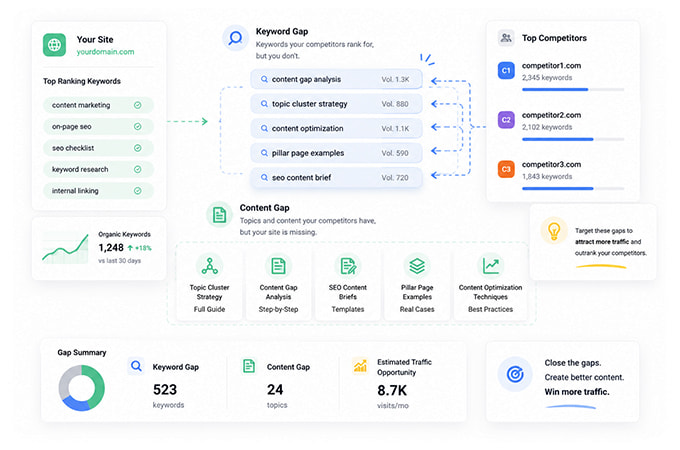
Step 5: Group Keywords Into Topic Clusters
Content gap keywords rarely exist in isolation. They usually belong to broader topic groups. For example, keywords such as competitor keyword analysis, keyword gap analysis, competitor content gap and how to find competitor keywords may belong to the same cluster.
Grouping them helps determine whether the opportunity requires:
- One comprehensive guide
- A pillar page with supporting articles
- A commercial landing page
- A tool or template
- Separate pages for distinct search intents
This reduces cannibalization and creates stronger internal linking paths.
Step 6: Map Each Cluster to the Correct Content Type
The format should match the dominant search intent. Possible formats include:
- Long-form educational guides
- Comparison pages
- Feature pages
- Definitions
- Checklists
- Templates
- Original studies
- Interactive tools
- Case studies
- Step-by-step tutorials
Do not automatically create a long blog post for every keyword. Some opportunities are better served by a concise landing page, a downloadable template or a product-led tutorial.
Reverse-Engineering Content Structure From Top-Ranking Pages
When a competitor consistently outranks your page, its result provides useful evidence about what Google and searchers may currently prefer for that query.
Reverse-engineering does not mean copying the competitor’s headings or expanding your article until it becomes longer. It means analyzing the complete search environment, understanding the strengths of the ranking page and identifying what a better result could provide.
Step 1: Perform a Full SERP Analysis
Visit the live SERP for the target keyword and review the complete layout. Record:
- Whether an AI Overview appears
- Which sources are cited
- Which SERP features are present
- The dominant page types
- The apparent search intent
- Whether videos, forums or product pages are prominent
- How much organic visibility remains above the fold
This prevents you from evaluating a competitor page without understanding the environment in which it ranks.
Step 2: Audit the Top-Ranking Page
Document the structural and qualitative characteristics of the competitor’s page. Review:
- Main title and search intent alignment
- H2 and H3 structure
- Answer placement
- Tables, lists, screenshots and videos
- FAQ coverage
- Author byline and credentials
- Publication and update information
- External references
- Structured data
- Internal links
- Calls to action
- Page depth and navigation
The purpose is to understand how the page helps the user complete the search journey.
Step 3: Analyze On-Page Entities
Review the people, companies, products, standards, concepts and tools referenced by the page. Relevant entity coverage can help demonstrate that a page understands the topic in context. However, mentioning more entities does not automatically improve quality.
Focus on whether important concepts are explained accurately and connected logically rather than inserted merely to create semantic coverage.
Step 4: Assess the User Experience
Load the page on desktop and mobile. Evaluate whether:
- The primary answer is immediately visible
- The page loads reliably
- The content is easy to scan
- Navigation is clear
- Advertisements interrupt reading
- Visuals improve understanding
- The page provides practical next steps
- The calls to action match the user’s stage
A technically detailed page can still underperform when it is difficult to use.
Step 5: Identify Differentiation Opportunities
The most valuable part of reverse-engineering is finding what the competitor’s page does not provide. Ask:
- Which important questions remain unanswered?
- Are the examples outdated or generic?
- Is there original data?
- Are practical steps missing?
- Does the page explain limitations?
- Could a table, template or workflow improve usability?
- Does the article connect the information to a real decision?
- Is the content written for beginners while the query suggests expert intent?
Your page should not become a rewritten version of the competitor’s content. It should offer a more complete, useful or distinctive solution.
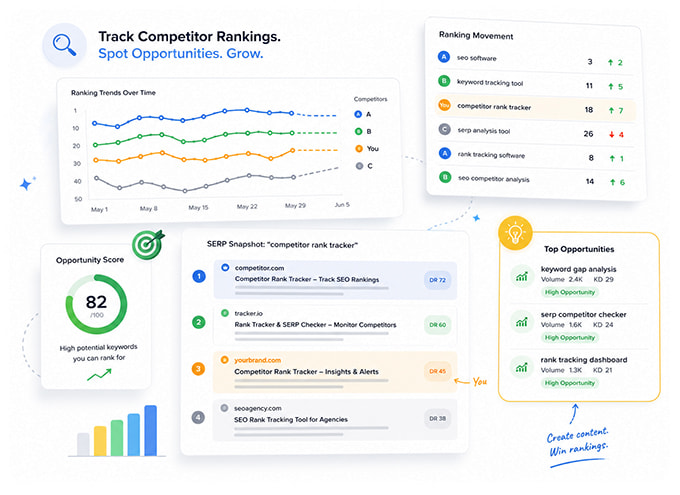
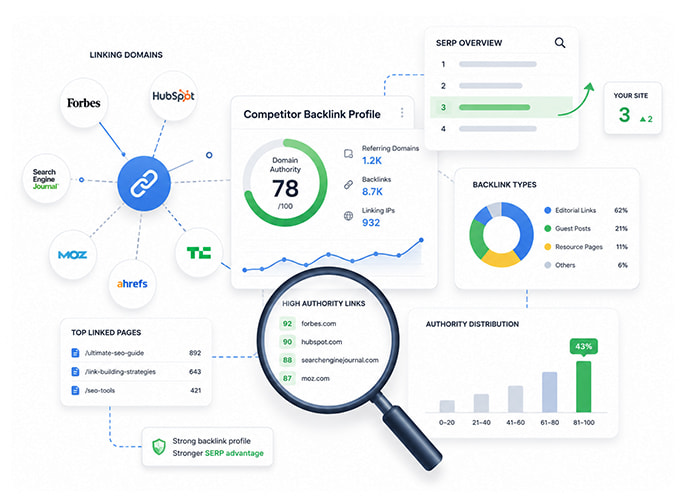
Analyzing Competitor Backlink Profiles for SERP Advantage
Backlinks remain one layer of competitive analysis, but useful backlink research requires more than comparing total link counts or domain authority scores.
The objective is to understand which links appear to support a competitor’s visibility, why those links were earned and whether similar sources or strategies are realistically available to your website.
A strong analysis should separate domain-level authority from page-level support. A powerful domain may rank a newly published page with few direct links, while a smaller competitor may depend heavily on links to a specific article.
Backlink Quantity and Quality Assessment
Measure the number of referring domains pointing to the competitor’s ranking page and review their relevance and authority distribution. Determine whether the page is supported by:
- A small number of highly authoritative links
- Many medium-authority editorial links
- Links from niche-specific websites
- Internal links from a powerful domain
- Large numbers of low-value or automated links
Total link count without source analysis can be misleading.
Link Source Type Analysis
Classify competitor links by acquisition type, including:
- Editorial coverage
- Industry publications
- Resource pages
- Tool directories
- Partner websites
- Community discussions
- Guest contributions
- Digital PR campaigns
- Original research citations
- Template or data references
The dominant source type often reveals why the competitor’s content attracts links.
For example, a page earning links through original statistics requires a different response from a page supported by partnership links or product directories.
Link Gap Analysis
Identify authoritative and relevant domains that link to competitor content but not to your website. These domains can become outreach targets because they have already demonstrated an interest in the topic. However, the competitor’s link does not mean the same site will automatically link to your page.
Before outreach, determine what additional value you can offer. This may include more current data, a stronger resource, an expert contribution, a useful tool or a correction to outdated information.
Link Velocity
Monitor how quickly competitors acquire new referring domains.
A sudden increase can indicate:
- A digital PR campaign
- Newly published research
- A successful tool or template
- Media coverage
- A product launch
- Deliberate link building
- Increased visibility causing natural citations
Link growth should be interpreted alongside ranking changes and content updates. A spike alone does not prove that links caused a movement, but it can reveal a competitor initiative worth investigating.
Monitoring Competitor AI Overview Citations
AI Overview citation monitoring adds a new layer to competitor intelligence because source visibility can change even when traditional organic rankings remain relatively stable.
The objective is to understand which competitors are repeatedly selected as supporting sources, which types of pages are cited and where your site is missing from AI-generated results connected to important queries.
Because AI-generated search experiences can vary by query, location, device and time, citation data should be treated as a pattern rather than a permanent result.
Manual Sampling
Search a representative group of strategically important queries and record:
- Whether an AI Overview appears
- Which domains are cited
- Which pages are used
- Whether your domain appears
- Which parts of the query the cited pages address
- Whether the cited source also ranks organically
Manual checks are useful for qualitative review, but they become difficult to maintain across a large keyword set.
Automated SERP Monitoring
A SERP monitoring platform can record AI Overview presence and source citations across tracked keywords at regular intervals. Within SerpVision, competitor monitoring should help teams compare their own visibility with the domains appearing across the same keyword set. When AI citation tracking is available for a monitored result, the data can be reviewed alongside conventional rankings and other SERP features.
Automation is valuable because it reveals trends that a single manual search cannot show, including:
- Citation frequency
- Newly cited competitors
- Lost citation visibility
- Query groups with repeated competitor ownership
- Changes following content updates
AI Citation Gap Identification
Queries where competitors are regularly cited but your website is absent may represent GEO and content improvement opportunities. Before updating a page, review:
- Whether your page directly answers the relevant question
- Whether the information is current and well-supported
- Whether important facts are easy to extract
- Whether the page demonstrates genuine expertise
- Whether the topic is covered comprehensively
- Whether the page is technically accessible
- Whether competitors provide original evidence or clearer explanations
The objective should be to improve the source, not to insert artificial phrases intended only for AI systems.
SERP Feature Competitive Analysis
Traditional rank comparisons can hide major visibility differences. Two domains may both rank within the top five, but one may own a featured snippet, appear in several People Also Ask answers and receive repeated AI Overview citations.
A SERP feature comparison table helps show where competitors capture additional attention beyond their standard ranking positions.
| SERP feature | Competitor A | Competitor B | Your site | Opportunity |
|---|---|---|---|---|
| Featured Snippet across 5 target keywords | 3/5 | 1/5 | 0/5 | High |
| People Also Ask across 10 target keywords | 7/10 | 5/10 | 2/10 | High |
| AI Overview citations across 10 target keywords | 6/10 | 4/10 | 1/10 | Very high |
| Image Pack across 10 target keywords | 2/10 | 3/10 | 1/10 | Medium |
| Video Carousel across 10 target keywords | 0/10 | 1/10 | 0/10 | Low |
The opportunity label should not be based only on the size of the gap.
Consider:
- Whether the feature attracts meaningful clicks
- Whether your content format is eligible
- Whether the feature appears consistently
- Whether the query supports conversions
- Whether the feature is dominated by a specific content type
- Whether producing the required format is commercially worthwhile
For example, a video carousel gap may be low priority for a query where users prefer detailed written comparisons. The same feature could be high priority for a software tutorial where visual demonstration is central to the intent.
Turning Competitor Intelligence Into a Content and Link Strategy
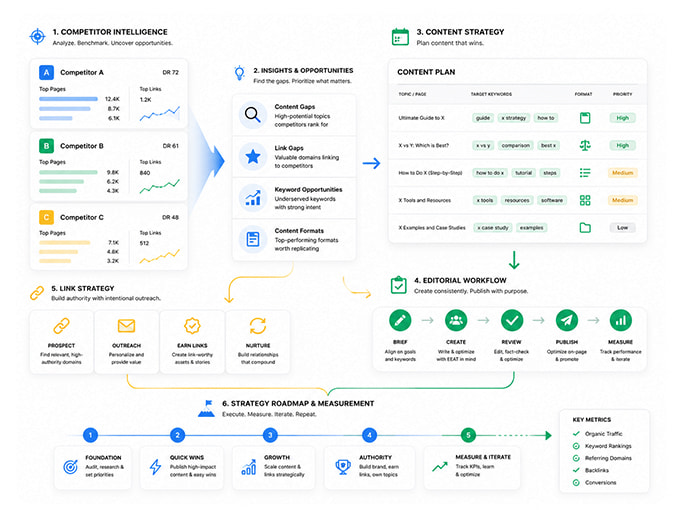
Competitive data becomes valuable only when it changes what your team does next. A common failure in SEO competitor analysis is producing large reports without converting the findings into content briefs, optimization tasks, outreach targets or monitoring rules. The final output should be a prioritized workflow with owners, deadlines and expected outcomes. The following monthly process provides a practical starting point.
Week 1: Review Keyword and Topic Gaps
Pull updated keyword gap data for your most important competitors. Identify a limited number of opportunities that:
- Match your audience
- Support an existing product or service
- Fit your topical expertise
- Have a realistic path to visibility
- Can be connected to a meaningful conversion action
Add qualified opportunities to the content roadmap rather than immediately creating pages for every missing keyword.
Week 2: Improve an Existing Page
Review competitor pages outranking your site across high-priority queries. Choose one existing page where an improvement is realistic and evaluate:
- Search intent alignment
- Missing subtopics
- Answer clarity
- Content freshness
- Internal links
- Visual support
- Page experience
- SERP feature eligibility
Update the page based on the identified user need, not merely because the competitor included more headings.
Week 3: Review Competitor Link Acquisition
Analyze new referring domains acquired by competitors during the previous month. Select several relevant sources and investigate why they linked. Determine whether the opportunity can be addressed through:
- A stronger resource
- Original data
- Expert commentary
- Partnership outreach
- Digital PR
- A useful free tool
- A template or checklist
Outreach should be based on a credible value proposition rather than a request to replace an existing link without justification.
Week 4: Review AI and SERP Feature Gaps
Compare AI Overview citations, featured snippets, People Also Ask appearances and other SERP features across priority keywords. Select a small number of high-value gaps and decide whether the appropriate response is:
- Updating an existing answer
- Improving page structure
- Adding evidence or examples
- Creating a visual asset
- Publishing a supporting article
- Building a dedicated video
- Strengthening internal links
- Creating an original data source
Document the action and continue monitoring after implementation.
Measuring the Results of Competitor SERP Analysis
Competitor analysis should be evaluated by the decisions and outcomes it produces, not by the size of the report.
Useful performance indicators include:
- New keywords entering the top 20
- Keyword gaps closed
- Competitor rank gaps reduced
- Featured snippets gained
- People Also Ask visibility gained
- AI Overview citation frequency
- New referring domains
- Updated pages recovering visibility
- Organic conversions from newly targeted topics
- Time between competitor movement and team response
Not every competitor action requires a reaction. The purpose of monitoring is to improve decision quality, not to imitate every page, link or content campaign a competitor launches.
Common Competitor SERP Analysis Mistakes
One common mistake is treating the highest-ranking domain as the only competitor that matters. Search visibility is distributed across many result types, and different domains may dominate organic listings, videos, discussions and AI citations.
Another mistake is copying competitor content structure without reviewing search intent. A competitor page may rank because of its authority, links or historical performance rather than because every element of the page is optimal.
Teams also waste resources when they target every keyword gap. Some gaps are irrelevant, commercially weak or better suited to a different type of website.
Finally, competitive analysis can become reactive. Your strategy should use competitor data as evidence, but the website still needs an original position, distinctive expertise and content that competitors cannot easily reproduce.
Conclusion
Every competitor that outranks your website provides clues about what is currently succeeding within the search environment. Their keyword coverage, content structure, backlinks, SERP feature ownership, AI citations and publishing activity can all help reveal opportunities.
The objective is not to replicate their strategy. It is to understand the systems supporting their visibility and identify where your own website can provide a stronger result.
Competitor SERP analysis in 2026 is an ongoing, multi-layer intelligence practice. Teams that combine automated monitoring with structured analysis and clear response workflows can identify changes sooner, prioritize opportunities more accurately and improve pages before competitive gaps become larger.
SerpVision helps you monitor where competitors outrank your pages, compare ranking movements across your keyword set and identify the queries where your next content or optimization opportunity may exist.
Instead of relying on occasional manual checks, you can build a repeatable competitor monitoring workflow that connects SERP changes to practical SEO actions.


Join the conversation
Share your question, add a practical note, or continue the discussion below.
No comments yet
Be the first to add a thought to this article.