
These elements are commonly known as SERP features. They are designed to present information in formats that help users complete different types of searches more efficiently.
For SEO professionals, SERP features are important because they influence where organic results appear, how much attention those results receive, and which additional forms of search visibility may be available.
A keyword with a featured snippet and several related questions creates a different opportunity from a keyword dominated by products and shopping advertisements. Understanding the available features makes it easier to select the right content format and set realistic expectations for organic traffic.
This guide explains what SERP features are, why Google uses them, how the most important features work, and what website owners can do to improve their eligibility for richer search appearances.
What Is a SERP Feature?
A SERP feature is an element on a search engine results page that goes beyond a conventional organic or paid text listing. Standard organic results usually contain a site name, title, URL, and descriptive snippet. SERP features present information in additional formats, such as maps, expandable questions, product carousels, highlighted answers, images, videos, or AI-generated summaries.ures
Google refers to many of these formats as search features or visual elements. Its search documentation describes visual elements as the building blocks of the search results page that users can see or interact with.

Some SERP features link directly to websites, while others provide enough information for a user to complete the search without visiting another page. Several features can appear on the same SERP, and their order may vary between desktop and mobile devices.
SERP features should not be confused with ranking positions. A page can hold an organic ranking and also appear in a search feature, while another page may gain visibility through a feature without occupying the highest conventional position.
Stop guessing where your pages rank on Google
Track keyword positions across different countries, locations and devices. See ranking changes, uncover new opportunities and react before your competitors do.
No complicated setup. Add your keywords and start tracking.
Why Does Google Use SERP Features?
Different queries require different types of answers. A written article may be appropriate for an in-depth explanation, but a map is more useful for finding a nearby business, while a product grid can help a user compare prices more efficiently.
Google uses search features to organize information according to the nature of the query. The objective is to reduce unnecessary steps and present relevant information in a format that supports the user’s likely intention.
For a simple factual query, a concise answer may be sufficient. For a local query, geographic information becomes essential. For a product search, images, prices, availability, and reviews may matter more than a long paragraph.
The appearance of a particular feature can therefore reveal useful information about search intent. When Google displays a local pack, it is a strong indication that location matters. When product results dominate, the query is likely commercial or transactional.
SERP features also allow Google to combine several content types on the same page. A user researching a complex topic may receive an AI Overview, organic articles, videos, and related questions, each supporting a different stage of the research process.
How Do SERP Features Affect Organic Visibility?
SERP features can affect organic visibility in several ways, and their impact should not be described as entirely positive or negative.
A large feature may push standard organic listings farther down the page, which can reduce the immediate prominence of those results. This effect is particularly noticeable on mobile devices, where a single feature may occupy much of the available screen.
Some features also answer questions directly, meaning that the user may not need to visit another website. A weather result, calculator, definition, or simple factual answer can satisfy the query immediately.
However, SERP features can also provide additional exposure. A website may appear in a featured snippet, video result, image pack, local listing, product result, or AI-generated response even when it does not hold the highest conventional organic ranking.
The correct SEO response is therefore not to avoid every keyword containing search features. Instead, website owners should determine which features appear, what type of content they use, and whether the business has a realistic opportunity to participate.
AI Overviews and AI Mode
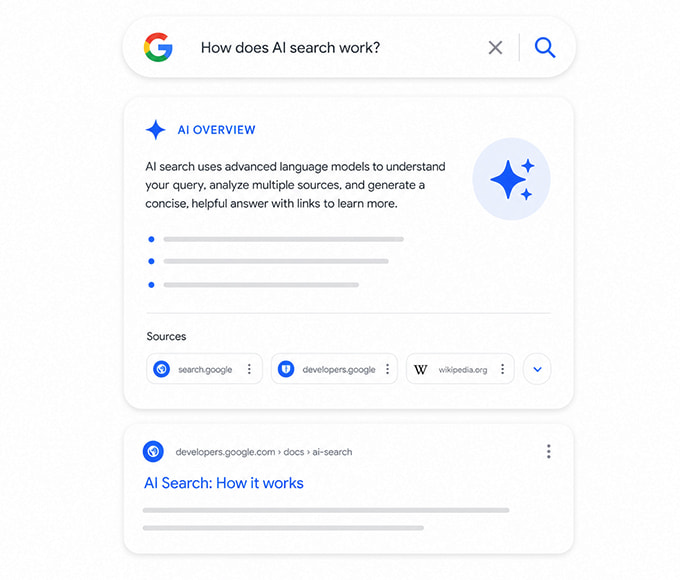
AI Overviews are generated summaries that may appear when Google determines that a combined response can help users understand a topic or complete a more complex search.
These summaries can include links to supporting web pages, allowing users to explore individual sources after reviewing the generated explanation. The feature may occupy a substantial amount of space and can change how quickly users reach conventional organic listings.
AI Mode provides a broader conversational experience in which users can ask complex questions and continue exploring through follow-up queries. Google explains that AI Overviews and AI Mode may use a query fan-out process, issuing multiple related searches across subtopics and data sources before generating a response.
From an SEO perspective, these features create a form of visibility that is not identical to a traditional ranking. A source may be linked within an AI response even when its standard organic position is not the highest result.
Google states that there are no additional technical requirements or special optimization methods required specifically for AI Overviews or AI Mode. The same foundational SEO practices remain relevant, and a page must be indexed and eligible to appear with a search snippet, although meeting these conditions does not guarantee inclusion.
Website owners should therefore focus on creating accessible, accurate, original, and useful content rather than treating AI visibility as a separate system that can be manipulated through a special markup format.
Featured Snippets
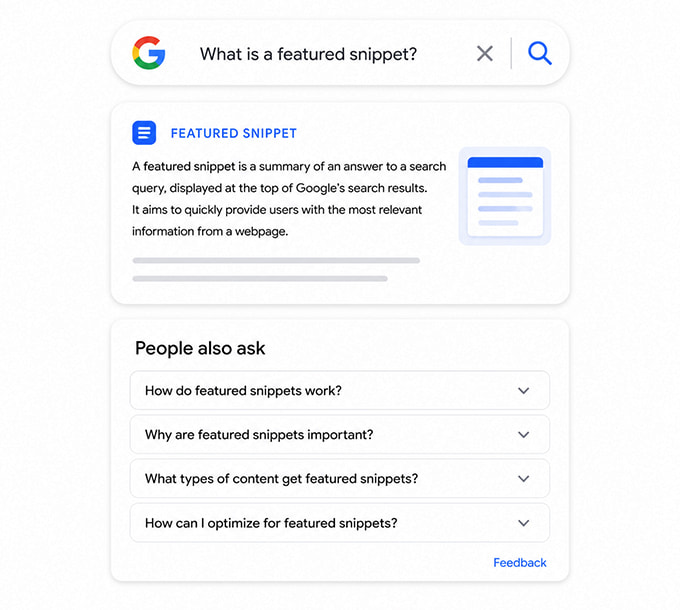
A featured snippet is a highlighted result that displays an extracted answer before the source link. Featured snippets commonly appear for queries that can be answered through a definition, short explanation, sequence of steps, list, comparison, or table. The exact format depends on the information Google considers most helpful.
Although featured snippets are sometimes described as “position zero,” their placement and appearance can vary. Google may also display similar extracted answers inside People Also Ask sections.
There is no dedicated featured snippet schema or meta tag that guarantees selection. Google decides whether a page contains a useful answer and whether displaying that answer prominently improves the search experience.
Content can support featured snippet eligibility by providing clear explanations, logical headings, accurate information, and complete answers. This does not require reducing an article to disconnected one-sentence blocks.
A well-written page can offer a concise explanation near the relevant heading and then continue with context, examples, limitations, and practical detail.
People Also Ask
People Also Ask sections contain questions related to the original search. Each question can be expanded to reveal a short answer and a source link.
The questions often change as users interact with the feature. Opening one result may cause additional related questions to appear, creating an exploratory path through the topic.
For content research, People Also Ask can reveal common concerns, alternative wording, and subtopics that users may want to understand. It can be particularly useful for identifying areas where an article needs more explanation.
However, the feature should not be used as a list of phrases to copy into a page. Adding every related question can create an unfocused article that attempts to cover several different search intentions.
The questions should be evaluated according to their relevance to the main topic. Some belong naturally inside the current page, while others may deserve separate supporting articles.
A focused page that answers the right questions thoroughly is generally more useful than a page containing dozens of shallow responses.
Knowledge Panels
Knowledge panels provide organized information about recognized entities such as companies, people, organizations, places, products, and creative works.
They may contain a description, images, official profiles, important facts, related entities, and links to additional information. On desktop, a knowledge panel may appear beside the main results, while mobile layouts may place it in a different position.
Knowledge panels are not conventional organic results. They reflect Google’s understanding of an entity rather than the ranking of one individual webpage.
For brands, consistent information across the company website, business profiles, official social accounts, and authoritative external references can help search engines understand the entity more clearly.
Organization structured data can also provide Google with administrative details and help distinguish one organization from another. Google notes that some organization properties can influence visual elements such as logos and knowledge panel information.
These actions do not guarantee that a knowledge panel will appear. Google decides whether the entity is sufficiently understood and which information should be shown.
Local Packs and Map Results
Local packs appear when Google believes that the user wants information about businesses, services, or places within a relevant geographic area. A local pack usually contains a map and several listings with information such as the business name, rating, address, opening hours, directions, and contact options.
The results can change significantly according to the user’s location. A business that appears prominently for a search performed nearby may be much less visible when the same query is submitted from another part of the city.
Local packs are common for restaurants, medical services, agencies, repair businesses, hotels, shops, and other organizations that serve customers in specific areas.
For local SEO, website rankings and business profile visibility should be considered together. The user may interact with the business directly through the map result without opening the website.
This means local success cannot always be measured through website clicks alone. Calls, directions, profile views, and other interactions can also represent valuable search outcomes.
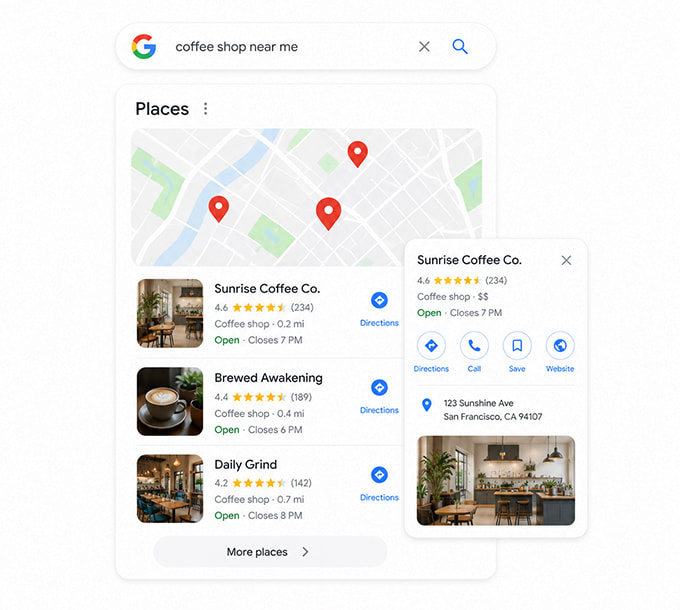
Image Packs and Image Results
Image features appear when Google determines that visual information can help satisfy the query. They may be displayed as individual thumbnails, rows, carousels, or larger collections. Image results are common for searches involving products, travel destinations, people, fashion, design, recipes, diagrams, and visual inspiration.
Google uses both the image and the surrounding page content to understand what the visual represents. Descriptive filenames, accurate alternative text, relevant captions, and placement near related text can provide additional context.
Original images can be particularly valuable because they provide information that may not exist on competing pages. Product photographs, screenshots, diagrams, charts, and process illustrations can all strengthen a page when they help the user understand the subject.
Adding a generic stock image to every section does not create the same value. Visual content should answer a question, demonstrate a process, or clarify information that would otherwise be difficult to communicate.
Video Results
Video features appear when demonstration, movement, instruction, or visual explanation may be more useful than text alone. They are common for searches involving software tutorials, product reviews, repairs, exercises, cooking, and step-by-step processes. Videos can appear as individual results or within a carousel.
Some video results include key moments that allow users to jump directly to a relevant section. This can make a long video more useful for users seeking a specific answer.
Embedding a video does not automatically make a page eligible for strong video visibility. The video should be central to the page, accessible to search engines, and supported by relevant context.
The page should explain what the video covers and provide useful information for users who prefer to read or cannot access the video.
For topics where users need to see a task performed, video can create a visibility opportunity that would be difficult to achieve through text alone.
Shopping and Product Results
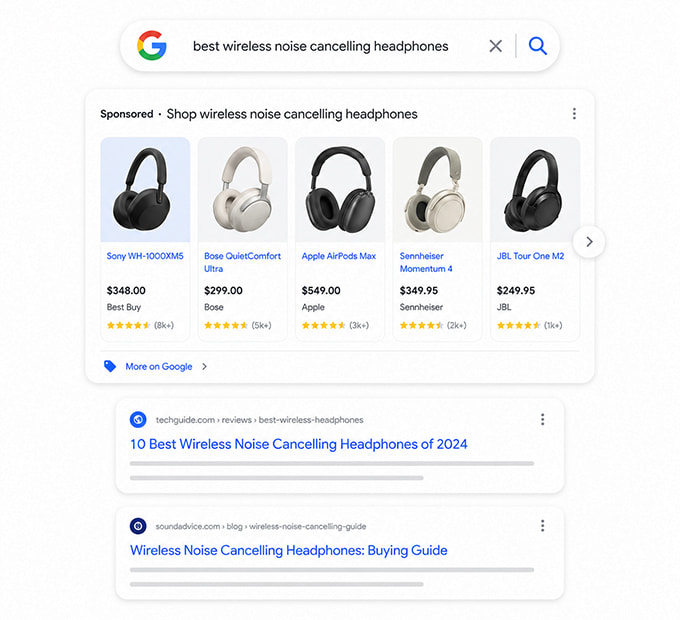
Product-related queries may generate shopping advertisements, organic merchant listings, product carousels, prices, ratings, availability, shipping information, and images. These features can dominate the search page when the user clearly intends to compare or purchase a product.
Google can use product structured data and merchant information to understand details such as price, availability, reviews, and shipping. Eligible information may appear in richer formats across Search, Images, and other Google shopping experiences.
For ecommerce businesses, product SERPs require a different strategy from informational SERPs. A general blog post may struggle when the results are dominated by product pages, category pages, and marketplaces.
The presence of shopping features is strong evidence that Google interprets the query as commercial or transactional. Website owners should therefore ensure that product pages contain accurate and current information, high-quality images, useful descriptions, and appropriate structured data.
Top Stories and News Results
Top Stories displays recent reporting related to the query. It frequently appears for breaking news, current events, public figures, companies, industries, and developing topics. The feature indicates that freshness is important to the current search intent.
An evergreen guide may be comprehensive and accurate but still lose prominence temporarily when users are primarily seeking recent information. This does not necessarily mean the evergreen page has lost quality. The results page may simply have shifted toward news intent because of an event, announcement, or controversy.
Historical SERP monitoring can help distinguish a temporary news cycle from a permanent change in the type of content Google prefers.
Publishers covering timely subjects should maintain accurate publication and update dates and ensure that genuinely new reporting is clearly distinguishable from older evergreen content.
Rich Results
Rich results are enhanced organic listings that display additional information beyond a standard title and description. Depending on the content type, they may include ratings, product details, event dates, recipe information, images, job data, or other structured elements.
Google uses structured data to understand certain types of page content and determine whether the page is eligible for a rich result. Supported structured data types are documented in Google’s Search Gallery.
Eligibility does not guarantee appearance. Google may decide that a standard result is more appropriate for a particular query, device, or user.
Structured data must also match the visible page content. Marking up information that users cannot see or providing misleading values can result in the loss of rich result eligibility.
A structured data manual action affects eligibility for rich results rather than directly lowering the page’s standard web ranking.
Sitelinks
Sitelinks are additional links from the same website that appear beneath or around the main search result. They can help users reach important pages such as pricing, documentation, login pages, product categories, or contact information without first visiting the homepage.
Google generates sitelinks automatically based on its understanding of the website structure. Website owners cannot manually select the exact links that appear. Clear navigation, descriptive page titles, and meaningful internal links can help search engines identify which pages are important and how they relate to the main result.
Sitelinks can increase the amount of visual space a brand occupies on the SERP and create faster paths to conversion-focused or informational pages.
They are particularly useful for branded queries where users may have several different reasons for searching for the same company.
Direct Answers and Instant Results
Google may display direct information for simple questions involving calculations, definitions, dates, weather, time zones, sports results, and unit conversions. These features can satisfy the user without requiring a website visit. Consequently, some queries can generate a large number of searches while producing limited external traffic.
This does not mean that creating content around these topics is always pointless. The important question is whether the user has a deeper need beyond the immediate answer. A simple definition may not attract many clicks, but a detailed explanation, calculator, comparison, or practical guide can still provide value.
Before targeting a direct-answer keyword, website owners should determine whether the topic offers enough depth to support meaningful engagement after the basic answer has been provided.
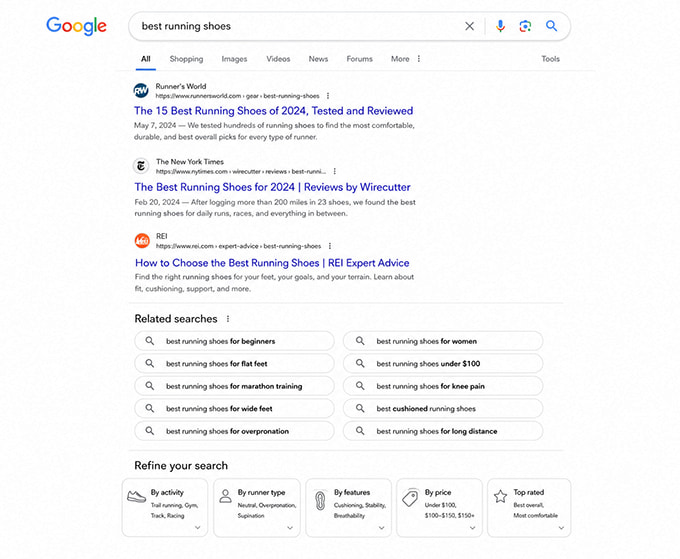
Related Searches and Search Refinements
Related searches help users refine, broaden, or redirect their search. They may reveal alternative wording, narrower questions, comparisons, connected entities, or different stages of the same research journey.
For SEO teams, these suggestions can provide insight into how users move from one question to another. Their value does not come from copying every phrase into the same article. Doing so can produce keyword stuffing and weaken the focus of the page.
Instead, related searches should be grouped according to intent. Closely connected questions may belong inside the current article, while broader or more specialized topics may be better suited to separate supporting pages.
This approach supports a stronger topic cluster without forcing one page to address every possible variation.
How Can Websites Improve Their Eligibility for SERP Features?
No method can guarantee a specific SERP feature. Google determines which format is useful for each query and which sources are appropriate to display. Website owners can nevertheless improve their eligibility by making content accessible, accurate, well organized, and suitable for the relevant feature.
Create Content That Matches the Query
The content format should match the type of information users need. A clear explanation may support a featured snippet, while a local query requires accurate business and location information. Product features depend on detailed product data, and visual searches require useful original images.
The presence of a feature should guide the content strategy rather than encouraging the same page format for every keyword.
Use Clear Content Structure
Logical headings and complete explanations make content easier for users and search engines to understand. Important questions should be answered clearly, but the article should not be broken into unnatural fragments simply to make extraction easier.
A strong structure allows the reader to understand the subject in sequence, while still making individual sections useful when viewed independently.
Use Supported Structured Data
Structured data should be implemented only when it accurately describes the visible page content and uses a format supported by Google. It can help Google understand information and make a page eligible for certain rich results, but it is not a general shortcut to better rankings or AI visibility.
Website owners should validate their markup with appropriate testing tools and monitor Search Console for errors or warnings.
Provide Original Value
Search features frequently reward content that provides useful information in a suitable format. Original photographs, firsthand examples, accurate data, practical demonstrations, diagrams, and clearly explained processes can differentiate a page from competitors that repeat generic information.
The objective should be to improve the user’s understanding rather than to reproduce the same content structure already visible across the SERP.
Final Thoughts
SERP features shape how users experience Google Search. They influence which results receive attention, how quickly users find answers, and whether a website can gain visibility outside conventional rankings. Some features create stronger competition for organic clicks, while others provide new ways for a page, product, image, video, or business to appear.
The most effective strategy is to understand which features belong to each query and create content that genuinely fits those formats.
Website owners should not attempt to force every page into every feature. They should identify the search experiences most relevant to their audience and invest in the content, data, media, and technical implementation needed to support those opportunities.


Join the conversation
Share your question, add a practical note, or continue the discussion below.
No comments yet
Be the first to add a thought to this article.